Nausea — Jean-Paul Sartre #2
About the event
What happens when the ordinary world suddenly loses its familiarity — and existence itself becomes impossible to ignore?
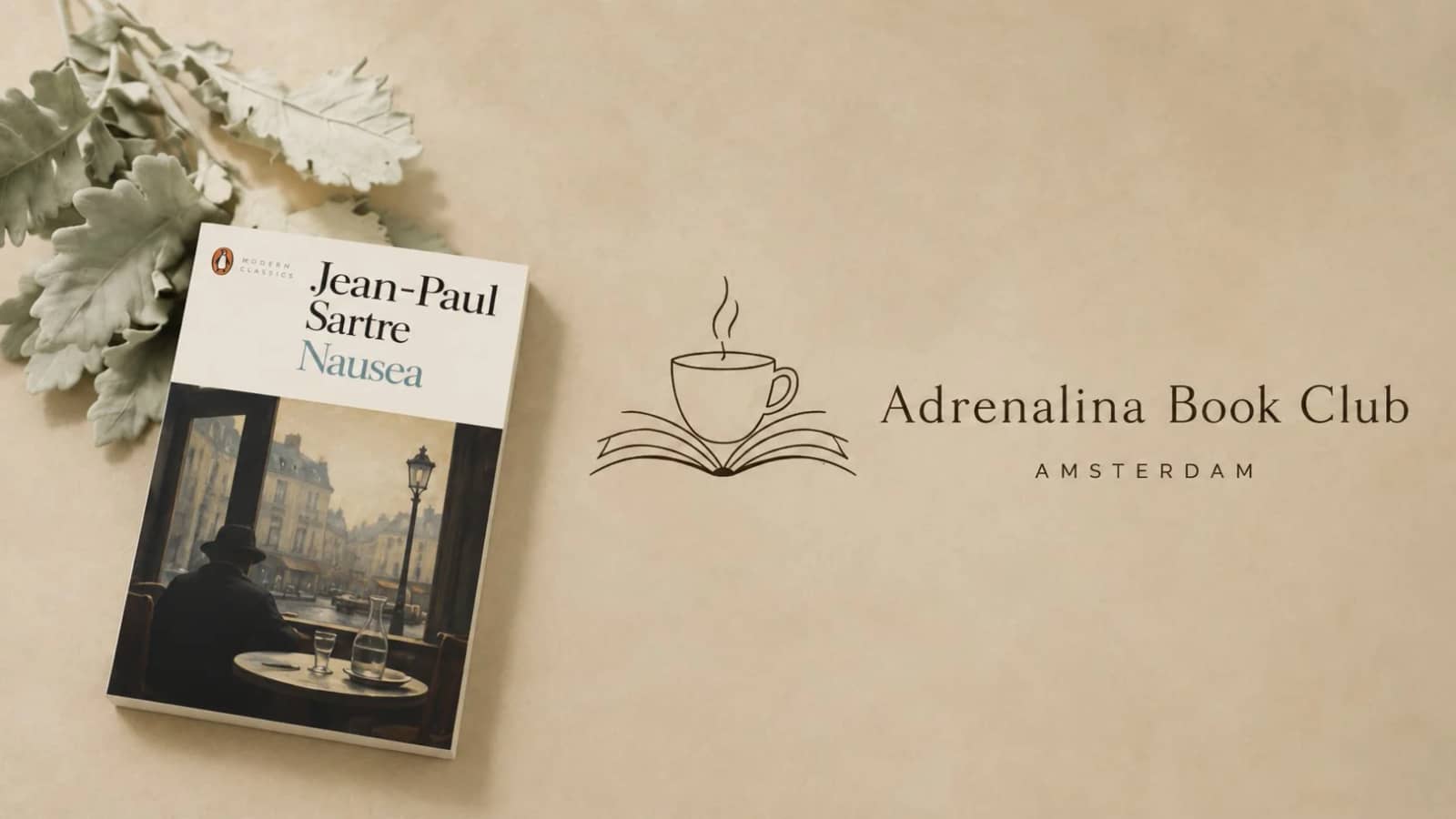
Jean-Paul Sartre’s Nausea is one of the defining novels of existentialism: a disturbing, philosophical, and deeply introspective exploration of existence, freedom, isolation, identity, and the search for meaning. First published in 1938, the novel follows Antoine Roquentin, a solitary writer living in the fictional French town of Bouville. While working on a historical biography, Roquentin begins to experience a strange and increasingly overwhelming sensation that he calls “nausea.” Objects, people, routines, and even his own existence start to appear unfamiliar and strangely arbitrary. Beneath the reassuring categories and stories through which we normally understand the world, Roquentin becomes intensely aware of the simple fact that things exist — without necessarily having a reason for doing so. Through his experience, Sartre explores questions that would become central to existentialist philosophy: What does it mean to exist? Is there any predetermined meaning to human life? What happens when we realize that we are radically free? And if meaning is not given to us, are we responsible for creating it ourselves? Written before Sartre formally developed many of these ideas in his later philosophical works, Nausea transforms abstract philosophy into a personal and unsettling experience.
About the Author Jean-Paul Sartre (1905–1980) was a French philosopher, novelist, playwright, essayist, and one of the most influential intellectual figures of the twentieth century. Born in Paris, Sartre studied philosophy at the École Normale Supérieure, where he met Simone de Beauvoir, who became his lifelong intellectual and personal companion. Sartre became one of the leading figures associated with existentialism. His philosophy emphasized human freedom, responsibility, consciousness, and the idea that human beings are not born with a predetermined essence or purpose. Instead, we continually define ourselves through our choices and actions. His major works include Nausea, Being and Nothingness, No Exit, Existentialism Is a Humanism, and The Roads to Freedom trilogy. In 1964, Sartre was awarded the Nobel Prize in Literature but famously declined it, arguing that a writer should not allow himself to be transformed into an institution. His work profoundly influenced philosophy, literature, psychology, political thought, and twentieth-century culture.
📖 Book You can find the book here: https://drive.google.com/file/d/1E0ROpAOvVUYBaROrcGUQMdGoopPPra0l/view?usp=drive_link
📚 How we choose the book
Prepare a list of your top 5 book proposals. If your list is selected via random.org, those five books will become the options for our next Book Club vote, and the group will decide which one we read together. 📖✨
When: Sunday 18 October, 14:00 Where: The Pulse Address: Hildegard Von Bingenstraat 4, 1081 LH Amsterdam
We’ll meet at 14:00 at the bar/foyer on the first floor at The Pulse. Grab a coffee or a drink, find us, and join the conversation. ☕📚 Look for the table with a book on it - that’s us! 📖
Looking forward to meeting you!