Ugly Sketch Walk. Chiaroscuro
About the event
Welcome to Ugly Sketch Walk — a monthly creative walk around Rome where we use sketching as a way to slow down, notice more, and experience the city differently.
This isn't about making beautiful drawings. It's about paying attention. Looking a little longer. Trying something new. And spending a couple of hours with curious people in one of the most beautiful cities in the world.
No drawing experience is needed. No pressure. No expectations. Just bring your sketchbook and your curiosity.
Why "Ugly"?
I called it Ugly Sketch Walk because I spent years believing I needed to draw *well* before I could enjoy drawing. Nothing changed until I gave myself permission to make terrible sketches. Ironically, that's when drawing became fun again. So that's our only goal: to make wonderfully imperfect sketches. Nobody's judging. Nobody's grading. Nobody's even looking. *(Unless you want to share!)* Just a playful invitation to slow down, get curious, and experience Rome in a more creative way.
This Month's Theme: Chiaroscuro
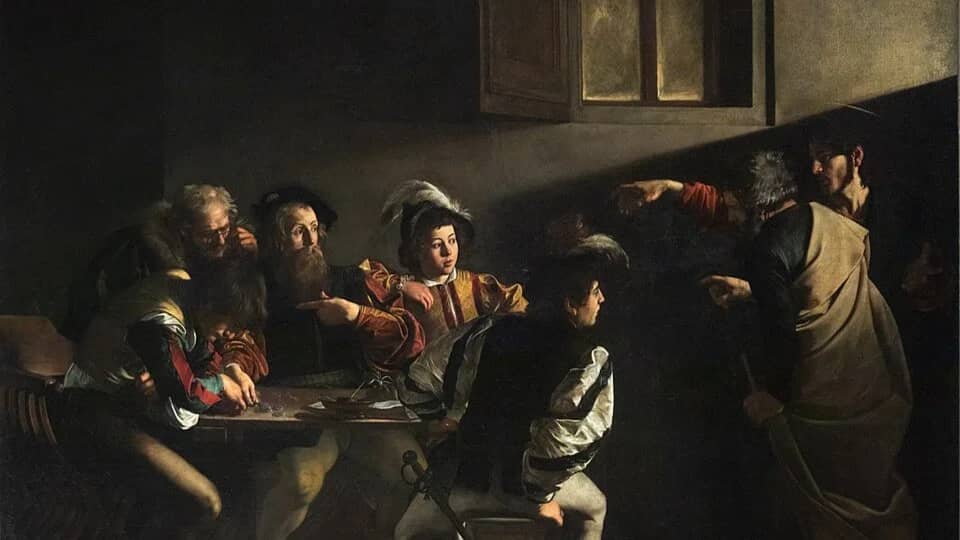
*Chiaroscuro* is an Italian word that means light and dark. The technique became famous thanks to one of the most influential artists of the early 17th century: Michelangelo Merisi, better known as Caravaggio.
Caravaggio was a superstar of his time — and he is still one of the biggest names in art today. And Rome is one of the best places to discover why.
He became famous for painting biblical and historical scenes that looked surprisingly real. Instead of making saints look distant and perfect, he used ordinary people as his models and placed them in scenes that felt almost like real life: dirty feet, tired faces, pain, movement, and moments of violence or miracle.
And then there was the light.
Caravaggio used an extreme contrast between light and darkness to direct our attention and make a particular moment feel almost physical. The light doesn't just show us what is happening — it tells us where to look and what to feel. That's what we'll take as our inspiration this month.
Our Route
We'll start at Piazza del Popolo, at Santa Maria del Popolo, where we'll see two of Caravaggio's masterpieces: *The Conversion of St Paul* and *The Crucifixion of St Peter*.
From there, we'll walk through the historic centre to San Luigi dei Francesi, home to three Caravaggio paintings in the Contarelli Chapel: *The Calling of St Matthew*, *The Inspiration of St Matthew* and *The Martyrdom of St Matthew*. A small coin in the light box brings the paintings out of the darkness — and suddenly the whole scene changes.
We'll finish at Sant'Agostino, where we'll find *Madonna di Loreto*, famous not only for its dramatic lighting but also for the unusually realistic, dusty feet of the pilgrims, which caused quite a stir at the time.
Along the way, we'll discover six original Caravaggio paintings, all in churches that are open to the public and free to visit.
And this is one of the things that makes Rome so special: some of the greatest works of one of the most famous artists in history are simply there, in ordinary churches, waiting for you to walk in and look. At each stop I'll share a short story to set the scene before we spend time looking, sketching and experimenting with the theme.
Creative Challenge
Every walk begins with a small creative challenge inspired by the theme of the month. I'll keep this one a surprise until we meet.
What this is (and isn't)
This isn't an art class, and it isn't a traditional guided tour. I'm not here to teach perspective, anatomy or perfect technique. Think of me as a creative companion who brings together an interesting corner of Rome, a monthly theme, a few stories to spark curiosity, and time to explore with a sketchbook in your hands. I'll happily offer ideas if you're feeling stuck, but there's no right way to draw here. The sketchbook is simply a tool to help us notice things we would normally walk past.
Who is this for?
This walk is for you if...
• you've always wanted to…