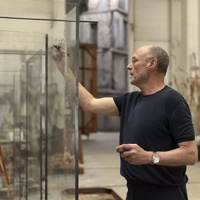
Anselm Kiefer reflects through his work on what it means to be an avant-garde artist in the 20th century. Through the ironic and provocative nature of his practice, he accepts and embraces the idea of the modern artist as an outsider to society, questioning its history, norms, taboos, myths and ideas about art. As a result of these concerns, he has produced work rooted in Germanic themes, values and symbols. His insistence on reopening emotional wounds and highlighting cultural loss becomes a way of exploring his own heritage and identity. In this sense, Kiefer believes not only in the regenerative power of art, but also in its capacity to establish a dialogue between history and civilisations, as an antidote to the horrors of human history and as a search for a path towards reconciliation. Kiefer’s vitrines are condensed symbols and often combine opposing concepts: they are transparent yet dense, light yet heavy, and the objects they contain are at once recognisable and enigmatic. Kiefer uses a wide range of materials, including lead, cement, glass, stones, wire, fabric fragments, tree roots and burnt books, which evoke ideas such as remembrance, renewal, hope and loss. These collected materials become artistic transformations of spiritual beliefs and ideas, and the vitrines, unsettling in nature, encourage reflection and inspire new interpretations. The exhibition at La Pedrera, featuring works from the Grothe Collection and other European private collections, is the artist’s first solo exhibition in the Spanish state devoted exclusively to this body of work, entitled Opus Magnum. La Pedrera will present a selection of these vitrines with books, objects and installations, complemented by a series of paintings dedicated to the English scholar and poet Robert Fludd (1574–1637).