Eau de Colony #1 — Amsterdam / New Amsterdam
About the event
📅 Sunday, 25 October 2026 🕒 15:00 📍 Amsterdam Centraal — city centre side
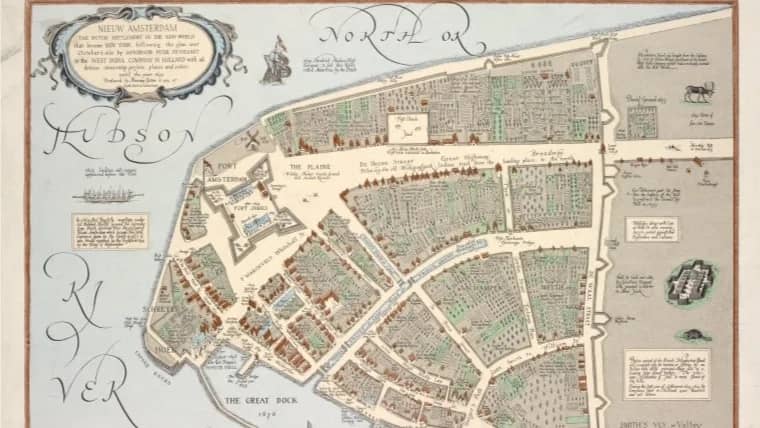
New York was once called New Amsterdam.
That much is fairly well known.
But what exactly connected Amsterdam on the Amstel to a small Dutch settlement on the other side of the Atlantic — and what can the streets of Amsterdam still tell us about the colonial system that connected them?
Welcome to Eau de Colony, a new series exploring the relationship between the Netherlands and its former colonies through the places where that history is still visible today.
For our first episode, we stay in Amsterdam.
During the 17th century, Amsterdam became one of the great commercial centres of the world. Its merchants, institutions and city government were deeply involved in overseas trade and colonial expansion, from Asia to Africa and the Americas.
Across the Atlantic, the Dutch West India Company established New Amsterdam at the southern end of Manhattan, the principal settlement of the colony of New Netherland.
It was a commercial outpost, but also part of a much larger colonial system: one built on the displacement of Indigenous populations, the exploitation of land and resources, and increasingly on enslaved labour.
In 1664, the English took control of New Netherland.
New Amsterdam became New York.
But the connections between the two cities did not simply disappear.
🚶 Amsterdam, seen differently
We’ll meet at Amsterdam Centraal and walk through the historic centre, looking for traces of Amsterdam’s colonial past in places that many of us probably pass without thinking twice.
Along the way, we’ll move between Amsterdam and New Amsterdam, using the story of Manhattan to explore the wider world of the Dutch West India Company, Atlantic trade, slavery and the extraordinary wealth that transformed Amsterdam itself.
This is not just a story about somewhere far away. It is also a story written into Amsterdam’s streets, canals, buildings and institutions.
And, as with all Eau de Colony events, the idea is not simply to talk about colonial history in general, but to discover what that history looks like when we go looking for it on location.
🍖 After the walk: Pendergast
For those who would like to continue, we’ll cross the Atlantic one last time — at least gastronomically — and head to Pendergast.
Pendergast is one of Amsterdam’s most convincing takes on an American barbecue restaurant, specialising in slow-smoked meats and the classics of US barbecue culture: brisket, burnt ends, pulled pork, ribs and plenty of sides.
Dinner is optional and separate from the walk.
If you are interested in joining us at Pendergast, please answer YES to the dinner question when you RSVP.
Once I have an idea of numbers, I’ll contact the restaurant and then get back to everyone who selected dinner with the final arrangements, price and payment details.
👟 Practical information
We meet at 15:00 outside Amsterdam Centraal, on the city-centre side.
Expect a substantial walk through central Amsterdam, so comfortable shoes are recommended.
The exact route will remain a surprise.
Participation in the walk does not require joining the dinner afterwards.
*
Four cities. Four colonial connections. And a history whose traces are often much closer than they appear.
Welcome to Eau de Colony**.