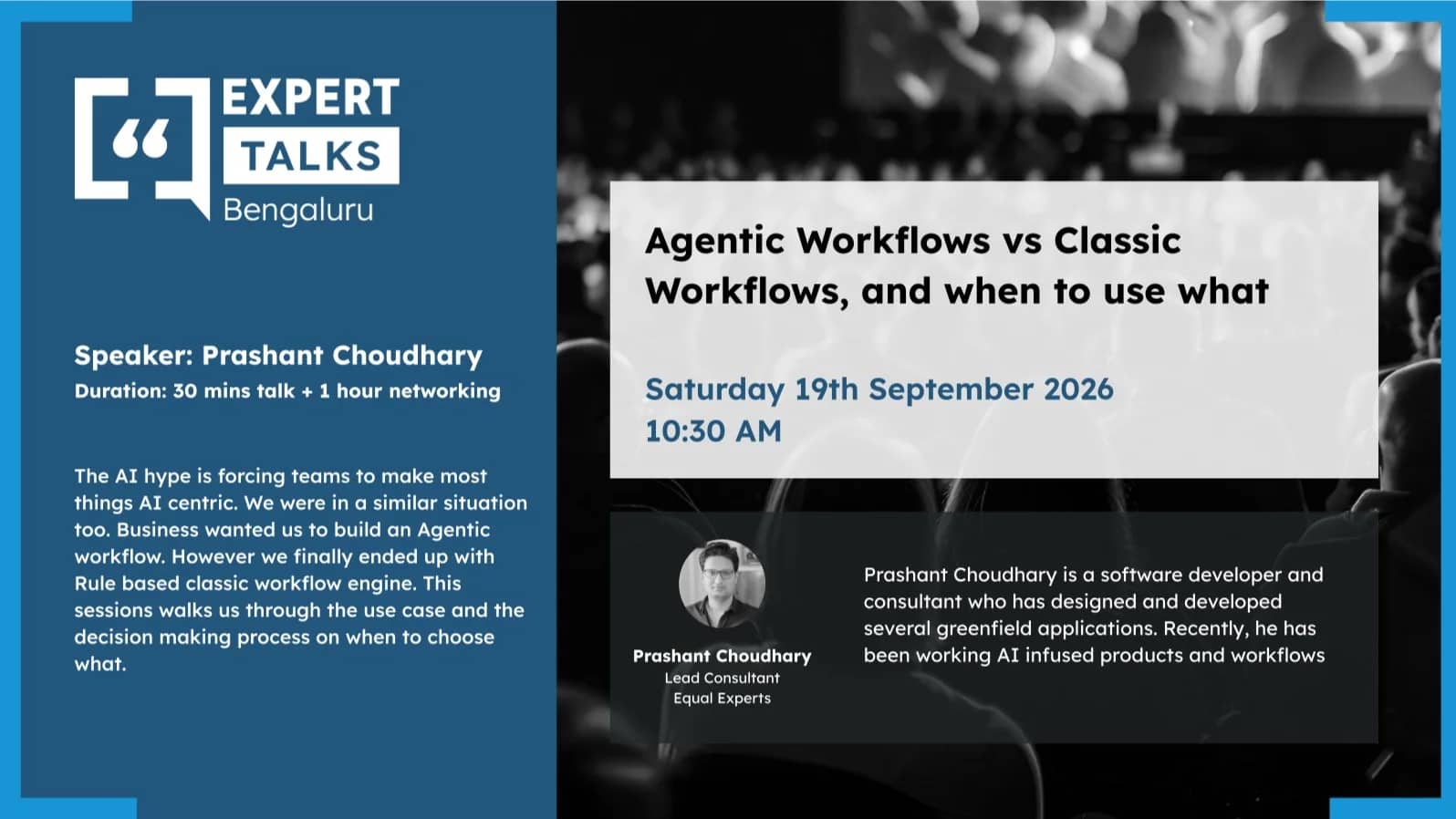
Agentic Workflows vs Classic Workflows, and when to use what
About the event
What the talk is about The AI hype is forcing teams to make most things AI centric. We were in a similar situation too. Business wanted us to build an Agentic workflow. The sessions walk us through the use cases where one or the other is more useful.
Outline
• Introduction and Context • The growing adoption of agentic workflows • Why agentic systems often become the default recommendation • The business and technical context behind our architectural decision • Workflows • What are workflows • High level Classic Workflows and Agentic workflows • Evaluating the Use Case • A sample use case • Identifying known steps, decision points, and outcomes • Technical Trade-offs • Reliability and predictability • State management and recoverability • Observability and debugging • Cost and latency • Failure handling and operational complexity • When to Use Which Approach • Use cases suited to classic orchestration • Use cases suited to agentic workflows • Decision criteria and practical design heuristics • Common pitfalls in choosing an execution model • Some existing workflows engines. • Hybrid Workflow Architectures • Combining deterministic orchestration with agentic components • Using agents for interpretation, planning, or judgment • Keeping state, retries, approvals, and controls in the orchestrator • Closing Takeaways • Choosing autonomy based on the problem, not the trend • Using orchestration for control flow and agents for judgment