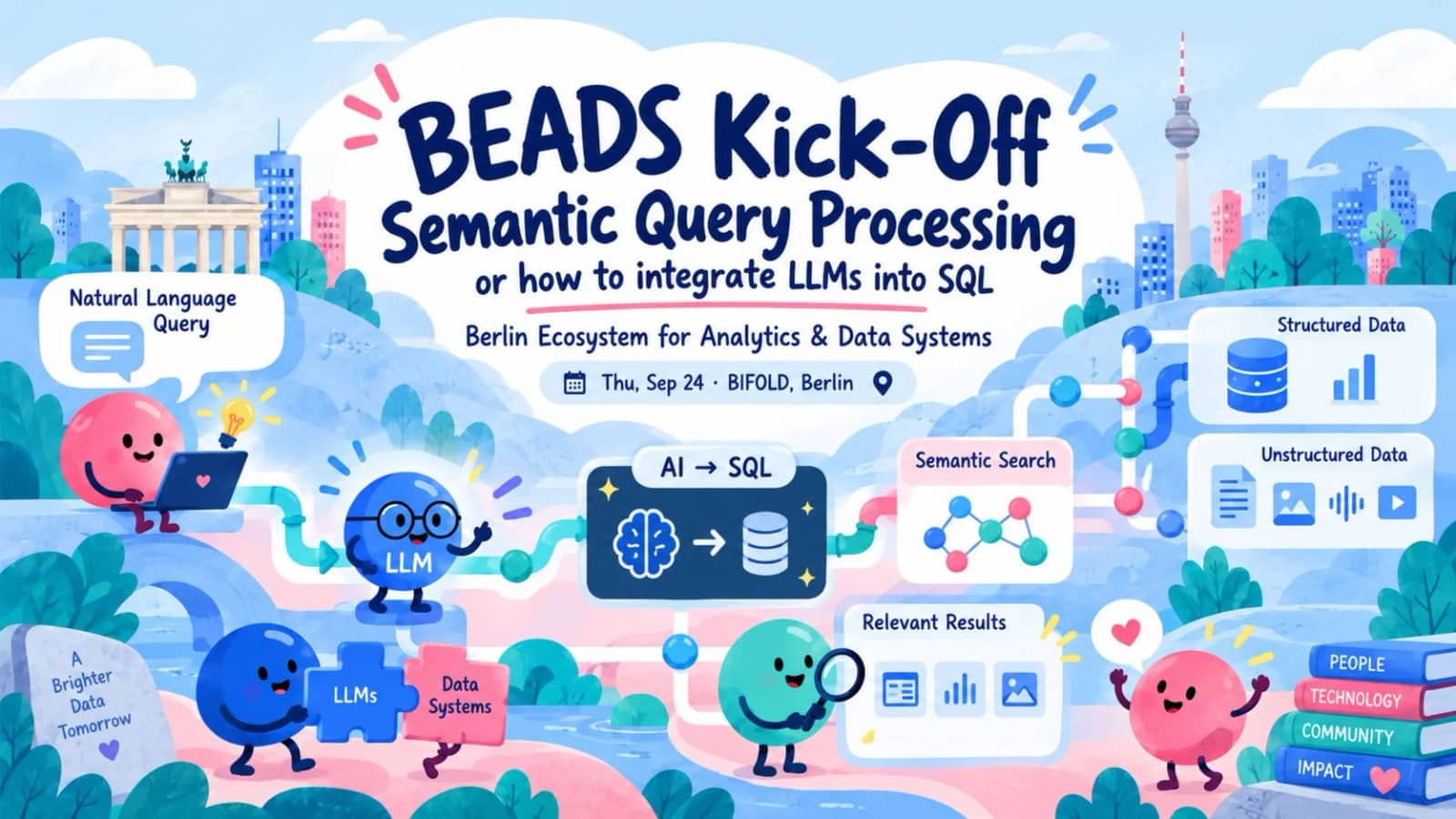
BEADS Kick-Off: Semantic Query Processing (or how to integrate LLMs into SQL)
About the event
Join us on the 24th of September for the first BEADS tech meetup. We're kicking things off with speakers from Snowflake, Databricks, and BIFOLD on semantic query processing, (integrating LLMs and AI functions into database queries) and AI governance.
Program:
Doors open at 18.00 and talks start at 18.30:
• Stefan Grafberger (Snowflake) — Bridging Relational Engines and AI: Querying Unstructured Data with AI SQL • Sven Wagner-Boysen (Databricks) — AI Governance: Humans Have Judgment. Agents Don’t. • Olga Ovcharenko (BIFOLD) — SemBench: A Benchmark for Semantic Query Processing Engines
Networking and drinks to follow.
Details on the Talks and Speakers:
Bridging Relational Engines and AI: Querying Unstructured Data with AI SQL. The growth of large language models (LLMs) has transformed how organizations interact with data. Modern enterprises now store vast volumes of unstructured content, such as documents, images, audio, and video, alongside traditional structured tables. This talk explores some of the core concepts behind semantic query processing and how modern database architectures like Snowflake bridge the gap between relational execution engines and unstructured data analysis. As part of the SQL Datatypes team, we work on the FILE and VECTOR datatypes that make these capabilities possible. In this talk, we will examine how Snowflake approaches building our system for unstructured data querying at scale with AI SQL. We will also break down the mechanics of executing AI functions within standard SQL queries and review key query processing optimizations designed to make semantic operations fast and cost-effective.
[Stefan Grafberger](https://www.linkedin.com/in/stefan-grafberger/) is a Software Engineer at Snowflake, working on improving unstructured data processing as a member of the SQL Datatypes team. Prior to Snowflake, he did his Ph.D. in data management for machine learning at the University of Amsterdam and BIFOLD / TU Berlin. He holds a Master's degree from TU Munich, where he also focused on database systems, and previously interned with Microsoft Gray Systems Lab, Amazon Research, and Oracle Labs. His research has been repeatedly published in top database venues like SIGMOD, VLDB, and CIDR, and received an ACM SIGMOD Best Demo Runner-Up Award. His code became part of systems like Snowflake, Umbra, and Deequ.
AI Governance: Humans Have Judgment. Agents Don’t. AI agents can reason, use tools, and take actions, but they cannot exercise human judgment or accept accountability. This talk shows how Unity Gateway can help organizations manage agent sprawl through agent identity, fine-grained access control, service policies, and secure reusable skills. We will explore why governance cannot simply be embedded in prompts, and how the platform can enforce guardrails, control costs, and traces activity across models, MCPs, and tools.
[Sven Wagner-Boysen](https://www.linkedin.com/in/sven-wagner-boysen-84231046/) is a software engineer at Databricks in Berlin. He focuses on enforcing user isolation and data governance for shared compute environments. His work includes Lakeguard for Apache Spark clusters and Unity Gateway for securing AI assets like Models, MCPs, and Agents. He holds a Master’s degree in IT Systems Engineering from the Hasso Plattner Institute.
SemBench: A Benchmark for Semantic Query Processing Engines. A new generation of database systems lets users query data multi-modal data with large language models (LLMs), e.g., asking a database to find positive movie reviews or flag pictures of damaged cars. Semantic query processing engines embed LLMs directly into the query engine. Despite growing interest from academia and industry, no systematic way exists to test and compare them. We introduce SemBench ([https://sembench.org](https://sembench.org)): a first semantic query processing benchmark that spans 55 queries across five realistic scenarios with text, image, and audio data. We evaluate research and…