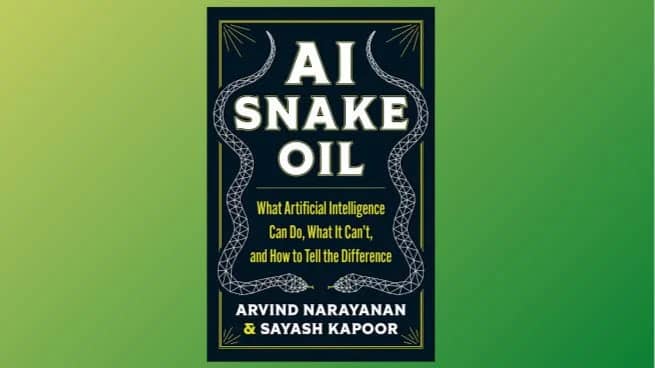
AI Snake Oil - Arvind Narayanan and Sayash Kapoor
About the event
🗓️ Date: Tuesday, October 27th 🕐 Time: 6:00 PM - 8:00 PM 📍Location: Spartacus Books, 1983 Commercial Dr #101, Vancouver
Join us for a discussion of AI Snake Oil: What Artificial Intelligence Can Do, What It Can't, and How to Tell the Difference by Arvind Narayanan and Sayash Kapoor. The synopsis and some tentative discussion questions are below. If as you read, you encounter some thought-provoking lines and/or find yourself wrestling with some burning questions, please note them down and bring them to the discussion! Whether you've read the whole book or just want to explore some of its central ideas, you're welcome to join; and if you need help accessing the text, please feel free to reach out to me directly.
Synopsis: In AI Snake Oil, Princeton computer scientists Narayanan and Kapoor argue that "AI" is an umbrella term covering technologies that differ greatly in what they can reliably do. They distinguish generative AI, which they regard as useful but overhyped, from predictive AI, which is used to forecast individual outcomes in areas such as hiring, criminal justice, healthcare, and welfare, and which they argue often performs little better than simple statistical baselines while harming the people it evaluates. The authors examine why AI struggles with content moderation, question both utopian and existential-risk narratives, and trace how companies, researchers, and media coverage together sustain inflated claims. They contend that many failures attributed to technology reflect underlying institutional problems that automation obscures rather than solves, and they offer readers a framework for evaluating AI claims along with recommendations for regulation and accountability.
Discussion Questions (subject to revision):
1. The authors separate predictive AI from generative AI and judge them very differently. Is this distinction clear and useful, or does it break down in practice? 1. They argue that predicting individual social outcomes (job performance, recidivism, academic success) faces inherent limits. Are these limits technical, or fundamental to how human lives unfold? 1. If predictive tools perform only marginally better than chance or simple rules, why do institutions continue to adopt them? 1. The book claims that AI is often deployed to paper over broken institutions. Can you think of examples where this applies, and cases where it does not? 1. How do the authors assess existential-risk arguments about AI? Do you find their skepticism well-founded or premature? 1. What role do journalists, academic researchers, and companies each play in producing AI hype, according to the book? Which incentive structure seems hardest to change? 1. Given how quickly generative AI has developed since publication, which of the book's claims have held up, and which may need revision? 1. What practical criteria from the book would you apply the next time you encounter a claim about AI capabilities?
Thanks to Spartacus Books for generously opening up their space for us! If you're able, please support them with a small donation (suggested: $2), or with a purchase if one of their titles catches your fancy.

.jpg)
