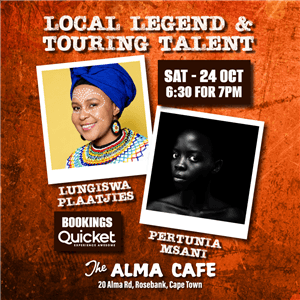
Pertunia Msani & Lungiswa Plaatjies
About the event
Join Pertunia Msani and Lungiswa Plaatjies for an exceptional evening of traditional sounds and local flavours at The Alma Cafe Tickets R175pp (show only)Fri & Sat 18h30 for 19h00 (kitchen orders close at 19h00)*Live Music Starts AFTER Dinner Service is completed*Dinner, Dessert and Drinks availableFully Licensed, BYOB not permittedAny Food / Beverage Not permitted unless by prior arrangementCard / Cash (preferred) Payment15% Service Fee Charged More on the Artists: Lungiswa Plaatjies: As an expert multi-instrumentalist, Lungiswa preserves traditional sounds while exploring new frontiers. She is famously one of the few women who have mastered and composed with the mbira, and performs beautifully with the marimba, djembe, kayamba, uhadi (gourd bow), and umrhubhe (mouth bow). Her work bridges history and innovation, digging deep into the roots of African melody and energetic isiXhosa dance (umxhentso). Born and raised in Langa, Cape Town, Lungiswa Plaatjies began her musical training in early childhood, performing at ceremonies and learning traditional rhythms. By age eight, she rose to international acclaim as the lead vocalist of the legendary group Amampondo. With Amampondo, she toured extensively throughout South Africa, Europe, the USA, Canada, and the Far East, bringing indigenous African music to the global spotlight. Pertunia Msani: Pertunia Msani is a South African performing arts practitioner, vocalist, and facilitator from Pietermaritzburg, KwaZulu-Natal. Her work is rooted in the understandingthat art has the fundamental responsibility to reflect life and bridge divides.She holds a degree in Drama and Performance Studies from the University of KwaZulu-Natal. She later joined Drama For Life at the University of the Witwatersrand, where she went on to serve as Theatre Company Director. Across her career, she has developed a practice that moves fluidly between performance and facilitation, always centring the human experience. As a vocalist, Pertunia works exclusively with the unaccompanied voice. Her EP, Izwi (“Voice”), is created without instruments, drawing on breath, texture, and herown lived experience. In this work, the voice becomes both an artistic and cultural archive — holding story, emotion, and a quiet sense of ceremony. Her practice has extended into international contexts through a residency in Miami with the Miami Light Project and The Centre for the Less Good Idea. There, she shared IZWI as both performance and method, using the voice as a point of departure for collaborative creation across disciplines. Sound became a guiding structure for visual and physical work, opening space for new forms of expression and exchange. Alongside her performance work, Pertunia facilitates workshops that invite participants to engage their own stories through voice and collective music-making. These spaces are carefully held, allowing for openness, listening, and connection to emerge in an organic way. Pertunia Msani’s work is defined by its clarity and intention — an offering that honours the voice as both a personal instrument and a shared language, capable of bringing people into deeper relationship with themselves and with one another.