The incredible known and wonderful hidden gems of Notting Hill
About the event
NEW WALK Hi all, cost & info below. Notting Hill daytime walk is only once every 2 years. Please note: Leaving at 12.30pm Please note approx 25-30 members will be on the walk, not what is advertised, as only half the members turn up with most meetup groups.
Please join us for a fascinating 3-mile circular walk of Notting Hill, known for hosting the annual Notting Hill Carnival and Portobello Road Market, but we are going to see much more along with some hidden gems!
(After this walk, there is an amazing Lantern Walk from Baker Street Station. If you link both the walks together, the other walk is HALF PRICE! There is a break in between the walks to briefly eat or drink locally before the next walk and the other walk is not far on the underground train)
So many things to see! Notting Hill the most successful British film of all time taking nearly $400 million sales at the box office, film locations [https://www.youtube.com/watch?v=a09MFuvfeJQ](https://www.youtube.com/watch?v=a09MFuvfeJQ)
Famous 'Notting Hill' film locations, famous people's homes of Bob Marley, Robbie Williams, Geri Halliwell, Annie Lennox, where sadly Jimi Hendrix died, where Band Aid's 'Do they know its Christmas' was made and countless other famous recordings for Island Records, the only 3 star Michelin restaurant in the UK run by a lady chef
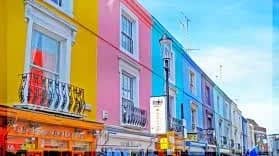
Banksy Art, famous Portabello Road and connections to the beginning of Notting Hill Carnival and of course the amazing colourful famous townhouses which we will see on our incredible walk. All in 3 miles!
WHERE TO MEET (Please allow 15 minutes to arrive before departure time) Please meet outside the front of McDonald's Restaurant, which is about 100 meters from Notting Hill Underground Station. The address for McDonald's is 108/110 Notting Hill Gate, London W11 3QA. Organiser Kevin will be wearing an Edwardian hat to greet you.
COST £10 cash/card payment by simply turning up on the day. There is no charge to RSVP beforehand on the Meetup event. Walks are normally 90% full before the day, so an early RSVP is advisable to avoid disappointment.
AFTER SOCIAL DRINKS/MEAL Sun In Splendour Pub, 7 Portobello Road, London, W11 3DA A small number of tables for 15 people have been reserved with the pub's allowance of the maximum amount of people
History of Notting Hill For much of the 20th century, the large houses were subdivided into multi-occupancy rentals, Caribbean immigrants were drawn to the area in the 1950s, partly because of the cheap rents, but were exploited by slum landlords and also became the target of white Teddy Boys in the 1958 Notting Hill race riots.
Known for its slum housing, in the early 21st century, after decades of gentrification, Notting Hill has a reputation as an affluent and fashionable area, known for attractive terraces of large Victorian townhouses and high-end shopping and restaurants
Notting Hill was in the county of Middlesex, a hamlet on rural land until the expansion of urban London during the 19th century. As late as 1870, Notting Hill was still referred to as being in Middlesex rather than in London.
Origin of the name The origin of the name "Notting Hill" is uncertain though an early version appears in the Patent Rolls of 1356 as Knottynghull, while an 1878 text, Old and New London, reports that the name derives from a manor in Kensington called "Knotting-Bernes,", "Knutting-Barnes," or "Nutting-barns", and goes on to quote from a court record during Henry VIII's reign that "the manor called Notingbarons, alias Kensington, in the parish of Paddington, was held of the Abbot of Westminster." For years, it was thought to be a link with Canute, but it is now thought likely that the "Nott" section of the name is derived from the Saxon personal name Cnotta, with the "ing" part generally accepted as coming from the Saxon for a group or settlement of people.
Notable residents Peter Gabriel, George Orwell, David Cameron, Michael Gove, John Christie,
ABOUT OUR LONDON WALKS It is a…