Past event — This event ended 48 days ago.
Canada: self-government
Registration with the organizer
Complete your actual registration on the organizer's website.
Found by Moments · Toronto History Salon
Is this your event?About the event
In the early 19th century calls for "responsible government" grew in Upper and Lower Canada, putting its supporters on a collision course with their governors and the ruling elites close to them (the Family Compact and the Chateau Clique respectively). The result was open rebellion in 1837, led by Louis-Joseph Papineau in Lower Canada and William Lyon Mackenzie in Upper Canada. Both rebellions were suppressed before long, but the British government was concerned enough to send Lord Durham as High Commissioner to investigate the situation.
Lord Durham's 1839 report recommended responsible government, in the naive hope of promoting the assimilation of French-Canadians. Upper and Lower Canada were united in 1841, and responsible government finally arrived with the 1848 electoral victory of Louis-Hippolyte Lafontaine and Robert Baldwin. (It had already arrived in Nova Scotia through the efforts of Joseph Howe.) Ottawa became Canada's capital in 1855.
To the west in what's now Manitoba, in 1811 Lord Selkirk sponsored the Red River Colony for Scottish emigrants, leading to friction with the Metis community and bloodshed at Seven Oaks in 1816. The rivalry between Hudson Bay and North West led to all-out war, ending in an 1821 merger. Further west, the coastal colony of British Columbia was founded in 1858, enlarged by gold seekers in the Fraser and Caribou valleys. (Some Americans had wanted the whole coast up to Russian territory--"Fifty-four Forty or fight!"--but the border was set along the 49th Parallel in 1846.)
The Canadian economy expanded as more immigrants arrived, not all British Protestants. (Refugees from Ireland's 1846 Potato Famine doubled Toronto's population overnight!) The infrastructure that would enable industrialization was being put in place, including canals, telegraph lines and the first railways. An 1854 treaty of reciprocity allowed the free trade of raw materials with the booming United States.
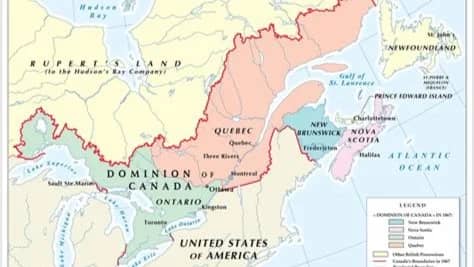
In the early 1960's the American Civil War forced the issue of uniting the colonies. When the Maritime colonies scheduled an 1864 conference in Charlottetown to discuss coming together, Canadian delegates invited themselves and persuaded the others to attend a Quebec City conference later that year. The result was the British North America Act, and Confederation on July 1, 1867. (But Prince Edward Island held out for six more years, Newfoundland for over 80.)
Our discussion will touch on:
The 1837 rebellions and their legacy. Canada's emerging western frontier. Growth of the once-precarious colony of Newfoundland. The controversial 1849 Rebellion Losses Bill. Fear of growing American power. Sir John A. Macdonald and the Fathers of Confederation. Resistance to Confederation.
We'll meet at Yorkville Village food court, at the round table near the west entrance.