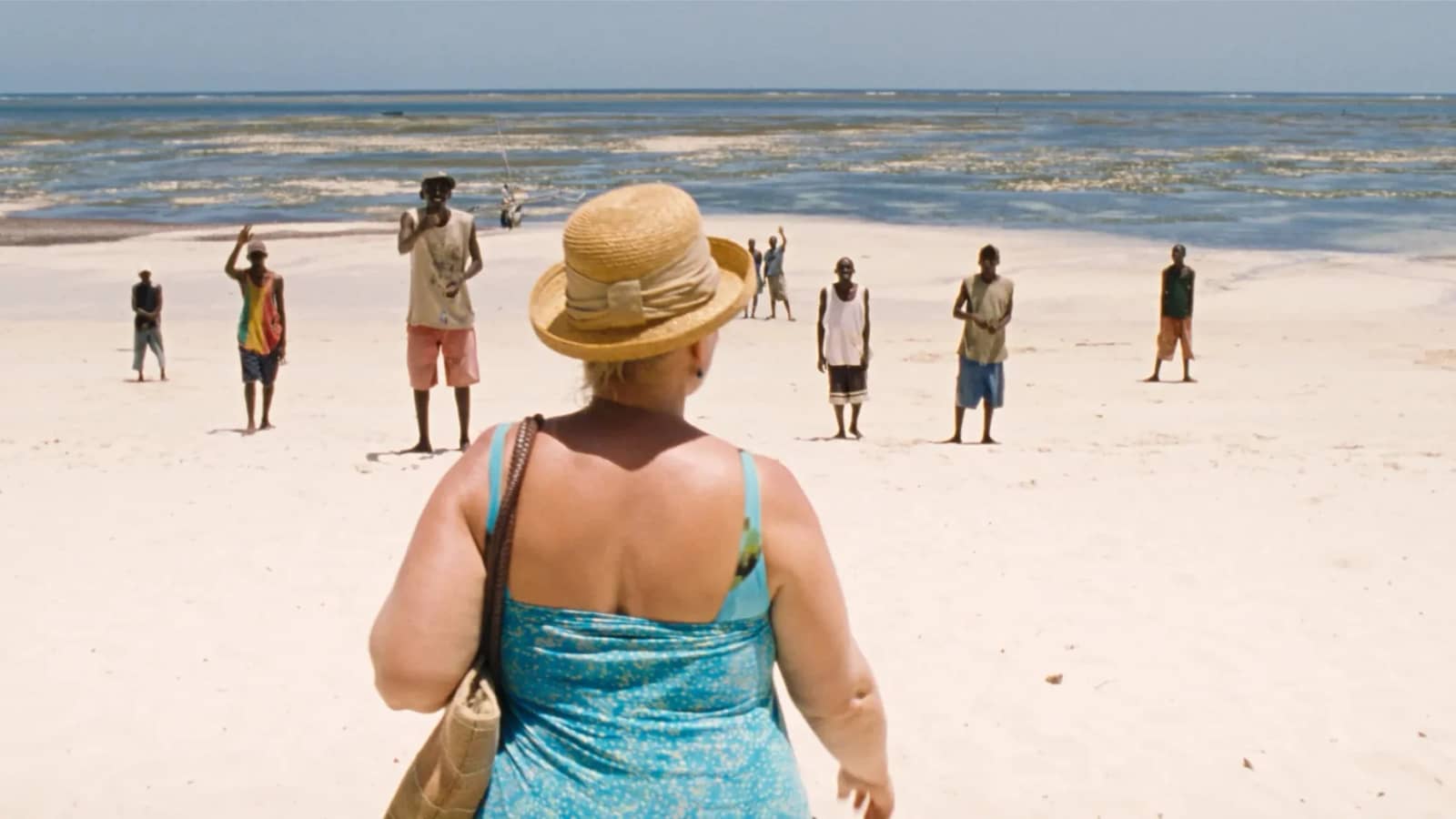
Great Exhibitions #24 — Ulrich Seidl: Life, Love and Death
About the event
📅 Saturday, 10 October 2026 🕒 15:00 📍 In front of Eye Filmmuseum, Amsterdam
Beautiful bodies. Ugly bodies. Lonely people. Strange desires.
Pets, basements, holidays, religion, sex, consumerism, death.
And an uncomfortable question running through all of it: are we looking at these people — or at ourselves?
For Great Exhibitions #24, we’re heading to Eye Filmmuseum for Ulrich Seidl — Über das Leben, die Liebe und den Tod, the first exhibition in the Netherlands devoted to one of the most distinctive filmmakers in contemporary European cinema. Eye accompanies it with the first complete Dutch retrospective of his films.
For more than three decades, the Austrian filmmaker has occupied a strange territory somewhere between documentary and fiction, observation and staging, cruelty and tenderness.
His subjects are often people cinema prefers not to show: old bodies, overweight bodies, outsiders, obsessive collectors, sex tourists, religious fanatics, people looking for affection in animals, objects, rituals or other people.
Seidl photographs them with an almost unnerving formal precision.
The result can be funny.
It can be grotesque.
It can be deeply moving.
And it is very often all three at once.
🎥 Inside Seidl's world
The exhibition follows Seidl's work from his early hybrid documentaries through his feature films, using material from across his career on a large audiovisual installation.
At its centre is his recurring interest in apparently ordinary people trying to find love, happiness, intimacy and meaninginside a late-capitalist society increasingly organised around consumption.
Eye describes the exhibition as an exploration of the *condition humaine* and of the prejudices we bring to the way other people live.
And that is where Seidl becomes particularly interesting.
His work has often been accused of being exploitative or misanthropic: of inviting us to laugh at vulnerable, eccentric or socially marginal people.
Seidl's answer is essentially to turn the accusation back on the viewer.
Who decided these people were ridiculous in the first place?
The discomfort may tell us as much about the person watching as about the person on screen.
We'll explore that tension throughout the exhibition: documentary versus performance, empathy versus voyeurism, ugliness versus beauty — and where exactly Seidl places us as spectators.
🍺 Afterwards: Pelusa
Afterwards, we'll walk about 15–20 minutes through Amsterdam Noord to Pelusa.
It's one of the most interesting places in the area for drinks, with a carefully curated beer programme, a strong focus on wild and spontaneously fermented beers, alongside cider and a particularly good wine selection. Their current drinks programme also includes twelve draft lines.
So we can stay for a beer or a glass of wine — and anyone who is hungry can also stay for food from their seasonal kitchen.
After one hour of Ulrich Seidl, we may need it.
Practical information
We meet at 15:00 in front of Eye Filmmuseum.
Please arrange your own admission to the exhibition (it's free with the Museumkaart, though).
Joining us at Pelusa afterwards is completely optional; food and drinks are paid individually.
A small warning: Seidl's work deliberately deals with uncomfortable subjects and includes nudity, sexuality, BDSM imagery, death, political extremism and other potentially disturbing material. This is very much not the exhibition for someone looking for a relaxing Saturday afternoon of pretty pictures.
No previous knowledge of Seidl's films is required.
Curiosity — and a reasonably strong stomach — probably helps.