Past event — This event ended 21 days ago.
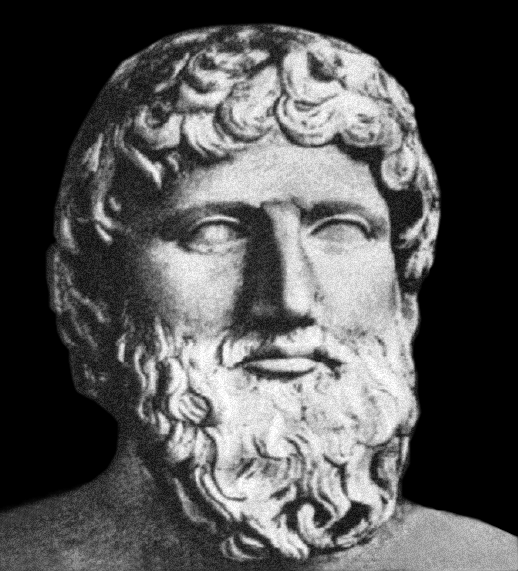
George Berkeley
Registration with the organizer
Complete your actual registration on the organizer's website.
Found by Moments · History of Philosophy Book Club
Is this your event?About the event
George Berkeley (1685-1753) was an Irish idealist philosopher and Anglican bishop born in Kilkenny, Ireland. Berkeley, California is named after him. Berkeley entered Trinity College in Dublin in 1700 at the age of 15 and became a fellow in 1707. He published his first book, “An Essay Towards a New Theory of Vision” in 1709 which later leads to his view that sensible qualities cannot exist “without the mind.” Berkeley was the leading exponent of 18th century idealism. He referred to his view as “the immaterialist hypothesis” in which he denied even the possibility of mindless, material substance in his radical opposition to materialism. Bertrand Russell in his book “History of Western Philosophy” humorously quotes a limerick response by Ronald Knox to Berkeley:
There was a young man who said “God Must think it accordingly odd If he finds this tree Continues to be When there is no one about in the Quad.”
REPLY
Dear Sir: Your astonishment’s odd: I am always about in the Quad. And that’s why the tree Will continue to be, Since observed by Yours faithfully, God
Berkeley’s thesis implies that ordinary physical objects exist if and only if they are perceived. He presents basically two arguments. First, he holds that every physical object is just a collection of sensible qualities, and secondly, that every sensible quality is an idea. Sensible objects are then objects that are capable of being perceived. Hence physical objects are just collections of ideas and no physical object can exist unperceived. From this he concludes that no objects can exist without the mind.
This principle and its supporting arguments are described and discussed by Berkeley in the two readings for our discussion. These are *Principles of Human Knowledge* and *Three Dialogues Between Hylas and Philonous*. Both are available in [a single collection published by Oxford’s World Classics](https://www.amazon.com/Principles-Knowledge-Dialogues-Oxford-Classics/dp/0199555176/ref=sr_1_1?crid=3E2VUXW2FTRWY&dib=eyJ2IjoiMSJ9.L9pgR2JsozIXbffK9HNcuTx63vKdjOkoz7ZDmtnrqJWjsONSUuTZoQdFFhTfT9iwOIxJrOFe3lWKCKwxjANjlTWHvSifGcb32OIVG199JLxeLL-d-ztreSzoWNcf1zXFVkq6e05mytGxNafJ4akPDDjVvxef5SHxNDKdmRK7vs4Rk3YRdt-p77spSKALYY5ks8HQbH76pdma4QcG8O0K86vNRumdHby5-abO2DDSVm0.zbWXZO17yPCiepx4cOOiM8Q_8daw53j4wCrZEpIuwwg&dib_tag=se&keywords=principles+of+human+knowledge+and+three+dialogues&qid=1785440899&sprefix=Principles+of+Human+Knowledge+%2Caps%2C108&sr=8-1). They are also available online as separate free ebooks from The Gutenberg Project ([gutenberg.org](http://gutenberg.org/)). See here for the *[Principles of Human Knowledge](https://www.gutenberg.org/ebooks/4723)* and the *[Three Dialogues](https://www.gutenberg.org/ebooks/4724).*
Secondary Material: [Wikipedia – George Berkeley](https://en.wikipedia.org/wiki/George_Berkeley) [Stanford Encyclopedia of Philosophy – George Berkeley](https://www.google.com/url?sa=t&source=web&rct=j&opi=89978449&url=https://plato.stanford.edu/entries/berkeley/&ved=2ahUKEwi-kfqrlvuVAxXWLFkFHQuQPF0QFnoECA4QAQ&usg=AOvVaw2eIqoXov8rQ6bOfMqJibAb) [Internet Encyclopedia of Philosophy – George Berkeley](https://www.google.com/url?sa=t&source=web&rct=j&opi=89978449&url=https://iep.utm.edu/george-berkeley-british-empiricist/&ved=2ahUKEwi-kfqrlvuVAxXWLFkFHQuQPF0QFnoECCMQAQ&usg=AOvVaw2F2wtIofLM2L7dbCw-DInT) [YouTube – George Berkeley: Subjective Idealism](https://youtu.be/FZmz9nkqBt4?si=tQ-88OJV9DI_bAGm) [YouTube – Philosophy of George Berkeley: Metaphysics and Theory of Knowledge](https://youtu.be/b0KLvn2hdik?si=E2zuI5A5b5d1VksH)