FREE! PIANO SPHERES - CHARLEMAGNE PALESTINE
About the event
FREE CONCERT, BUT YOU MUST RSVP. READ INSTRUCTIONS BELOW. SUGGEST YOU RSVP ASAP!
Date: October 7 @ 8:00 pm - 10:00 pm
Possible dinner before TBD
Venue: The Brick temporary annex 619 N. Western Ave, Los Angeles, CA 90004 [+ Google Map](https://maps.google.com/maps?f=q&source=s_q&hl=en&geocode=&q=619+N.+Western+Ave+Los+Angeles+CA+90004 "Click to view a Google Map") Phone (323) 848-4140
Tickets: Free, but you must RSVP here: [https://pianospheres.org/tickets/](https://pianospheres.org/tickets/) I suggest you do this ASAP!
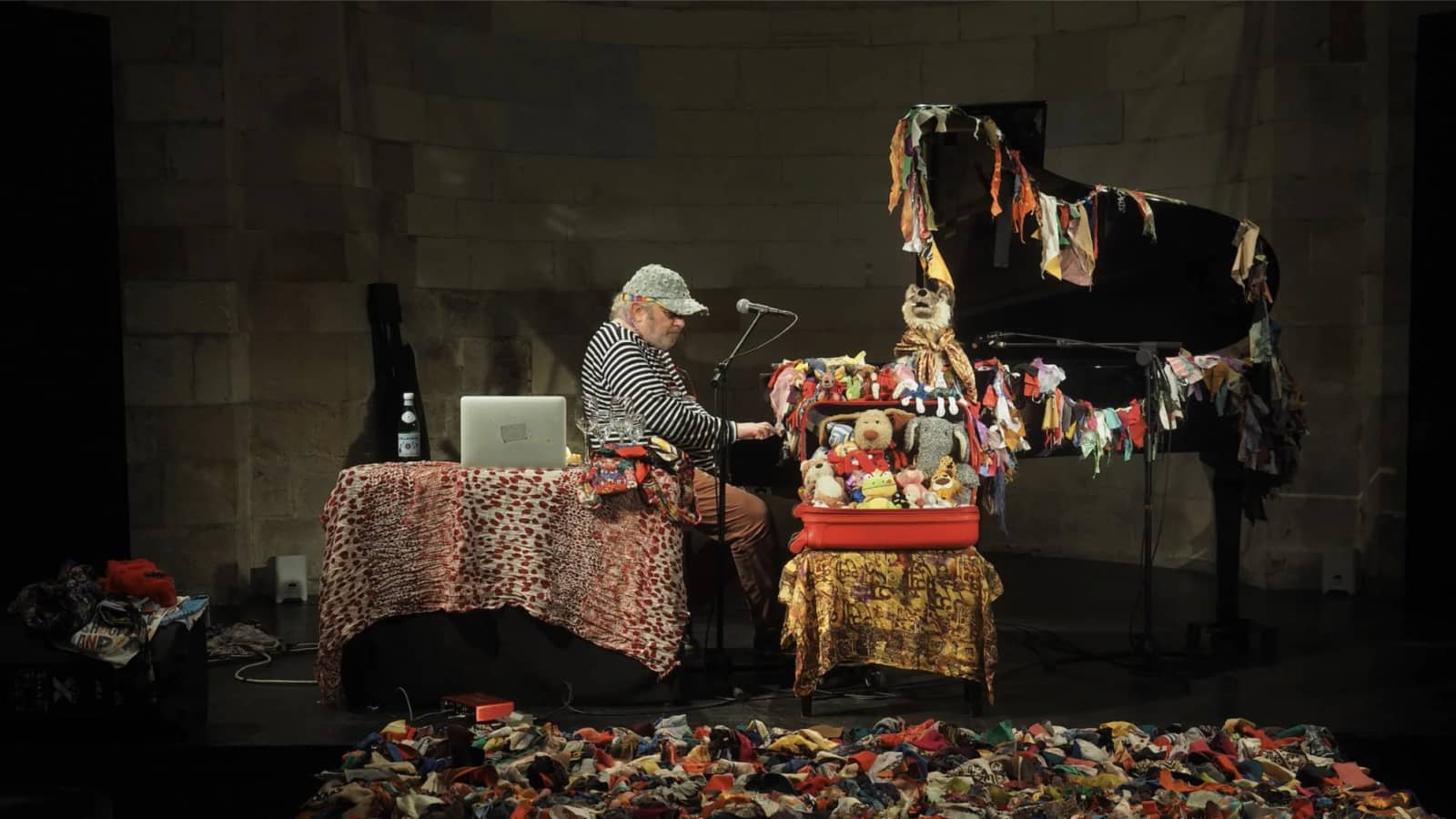
“GRADUALLY MY ARPEGGIOS BEGAN TO BECOME STRUMMMMMSSSSS AND STRUMMMMINGGGGSSSS” Charlemagne Palestine returns to Los Angeles for a rare performance of his monumental Strumming Music, which he has been developing since the early 1970s and describes as an approach and technique that is always different. “It is not a ‘composition’ as such” he says, “it is an evolutionary liquid sound continuum process that I have presented hundredsss of versions that I have performed over the last 50+ years.”
NOTE: Piano Spheres is pleased to partner with The Brick to offer this season kickoff as a free concert. Tickets required, limit 2 per patron. Ticket holders must be present 30 minutes before start time, or seating is not guaranteed. Please make careful note of venue address: The Brick temporary annex – 619 N. Western Ave, LA CA 90004
Born in 1947, Chaim Moshe Tzadik Palestine, known as Charlemagne Palestine, came from a Russian Jewish family who left Odessa and Minsk at the dawn of the twentieth century to settle in Brooklyn, New York. He began his musical training singing traditional synagogue musics. From the age of 7 until 14, he was a member of the Stanley Sapir traditional chassidic music choir singing in synagogues all over the east coast of America. Later he enrolled at the High School of Music and Arts in upper Manhattan and studied voice, accordion, piano, drawing, painting and sculpture, and immediately developed an interest in the composers who were creating sounds using recording tape techniques and generating sounds by electronic music machines as well as non-western musics from all over the world that he discovered listening to disks from the Folkways label founded by Moses Asch. In 1963, he became the bell ringer at St. Thomas Episcopal Church in New York City, located next to the Museum of Modern Art (MoMA). Every day for six years, he played traditional Protestant hymns as well as inventing an experimental sound approach using the large resonant church bells as his sound source and devised a soap opera sequence of hundreds of variations of complex bell sonorities every day at 5pm for several years. His performances resonated throughout the church’s surroundings and attracted the attention of thousands passersby each afternoon, including artists, choreographers and composers like Alwin Nikolais, Len Lye, Moondog, John Cage, Tony Conrad, and Ingram Marshall.
He took advantage of the geographical proximity to MoMA to become a regular visitor of the museum and explore all the museum’s collections, where he discovered French Impressionists and American Abstract Expressionist painters who were a revelation and inspiration to him. The color explorations of Monet, Seurat, Rothko, Albers, Still and others became one of the catalysts for his own aesthetic quest. He imagined inventing a continuous sound form that paralleled the visual artists canvases and structures and imagined created sound canvases and structures that continued to exist nonstop and always present as visual art works were.
During this period, he associated with numerous figures of the artistic avant-garde and counterculture: Allen Ginsberg, Kenneth Anger, Richard Serra, Tony Conrad, Steve Reich, Gordon Matta Clark, Philip Glass, Jean Dupuy, La Monte Young, Sol LeWitt, Terry Riley, and many others. Following a meeting with electronic music composer Morton Subotnick at his New York University electronic music studio in 1967 he began to compose…